
Home > Safety & Detection > Motorhome CO Monitoring by Aurora
Twenty-two years. Over 4,000 motorhomes. The same green light on the wall every single time. And one van where it was working perfectly, and it didn't matter at all.


A working alarm. A clean certificate. And a man who didn't check out.
I want to start with the job I still think about, because everything else in this article follows from it.
Four winters ago I was called out to a site to look at a van after the fact. A man in his sixties, on his own, February, everything shut up tight against the cold the way you would. He was found the next afternoon by the warden, because he hadn't checked out.
There was a carbon monoxide alarm on the wall of that van.
Four months old. Recognised brand. Bought because he was being responsible.
The green light was still on.
And here is the part I could not get out of my head for about a year afterwards.
It wasn't broken.
I tested it. The sensor was fine. The battery was fine. The sounder was fine. That alarm was working exactly as it was designed to work, right up until the moment it stopped mattering.
It just wasn't designed to help him.

The alarm isn't failing. It's obeying.
YOUR ALARM ISN'T BROKEN. IT'S BUILT TO WAIT.
Carbon monoxide alarms sold in this country are built to a standard called EN 50291. And that standard does not merely permit your alarm to stay quiet at low levels.
It requires it to.
That is not a cheap alarm being cheap. That is every compliant alarm in Britain — the fifteen pound one and the forty pound one — doing precisely what it was engineered to do.
And there is a sound reason for it, which I want to be fair about.
An alarm that goes off every time you fry an egg gets taken off the wall and put in a drawer. A device that cries wolf is genuinely dangerous, because nobody listens to it when it matters. So the standard is written to catch the night that kills you and to ignore absolutely everything underneath it.
Sensible engineering. And completely useless to somebody lying awake at four in the morning wondering why their head hurts.
Most people think a CO alarm is a detector.
It isn't. It's a last resort.

This is the part that frustrates engineers who actually understand what is on that wall.
When an owner starts worrying, they buy a second alarm and put it at the other end of the van. Two green lights instead of one. Twice as reassured.
But a second alarm isn't twice the information.
It's the same single answer, twice.
And it compounds in the wrong direction. Every year the alarm doesn't sound, you trust it a little more. It has never let you down, because nothing has ever happened. So you check it less. Eventually you stop seeing it at all — it becomes part of the wall, like a light switch.
Meanwhile the sensor ages, in a vehicle that vibrates at seventy miles an hour, tilts on every grass pitch, freezes in February and bakes in August.
And silence is the only feedback it can ever give you.
Silence looks exactly the same whether the sensor is working perfectly or died two seasons ago.
You are not more protected in year eight than you were in year one. You are just more confident, with less reason to be.
This is the one that genuinely surprises people, including owners who have been at it twenty years.
There are two dangers in a motorhome. Not one.
The first is carbon monoxide. That's fuel burning badly — a Truma with a partly blocked flue, a fridge burner on a van sitting off level, a wasp nest in a vent, a neighbour's generator drifting in through the ventilation.
The second is raw gas. Unburnt propane or butane escaping from a loose connection, a perished hose, a regulator on the way out, a hob tap knocked open by a bag on the drive down.
They are different molecules. They behave differently. They need completely different sensors.
Your carbon monoxide alarm cannot detect raw gas. Not a little. Not at all. It is chemically incapable of it.
Which means the gas cylinder locker — which on most vans sits a few feet from where somebody sleeps — is covered by nothing whatsoever.
Two alarms on the wall. Half the problem.

The same post, over and over, on every owners' forum there is.
After that February job I went looking for something that would give an owner an actual number instead of a light.
Not another alarm. A gauge.
I bought six different units over about four months. Spent close to £300 of my own money.
Most of them were the same thing in a different shell. A light in a plastic box. One of them had a digital display that only showed a reading once it had already decided there was a problem, which is the same device with extra steps.
Am I wrong about this?
I didn't give up. I went back and read the standard properly, end to end, and then I read what the research actually says about how these poisonings happen.
That's when it clicked.

Six cubic metres of air. A gas appliance burning in it. And a metre between the two.
Finding 1: Public Health England puts accidental carbon monoxide deaths in England and Wales at around 30 a year, with roughly 4,000 people attending A&E annually because of carbon monoxide poisoning. It is not a freak event. It is a small, steady, entirely preventable number.
Finding 2: A study of coroners' narrative verdicts in England and Wales covering 1998 to 2019 found that two thirds of fatal unintentional carbon monoxide poisonings happened in autumn or winter. Not summer. The months when everything is shut up tight and the heater runs all night.
Finding 3: A house breathes whether you want it to or not — chimneys, air bricks, gaps in the fabric, doors opening all day. A motorhome has around six cubic metres of air and a handful of deliberate vents, and that is the entire air exchange the vehicle has.
Put those three together and you get the thing nobody explains at handover.
The risk peaks in exactly the season when owners seal the van up, and the alarm is required to stay silent through exactly the range where it starts.
So what does an owner actually need? Four things, and they only work together:
One of those on its own changes nothing. I have watched owners buy a carbon monoxide meter with no display and come back confused about why it told them nothing.
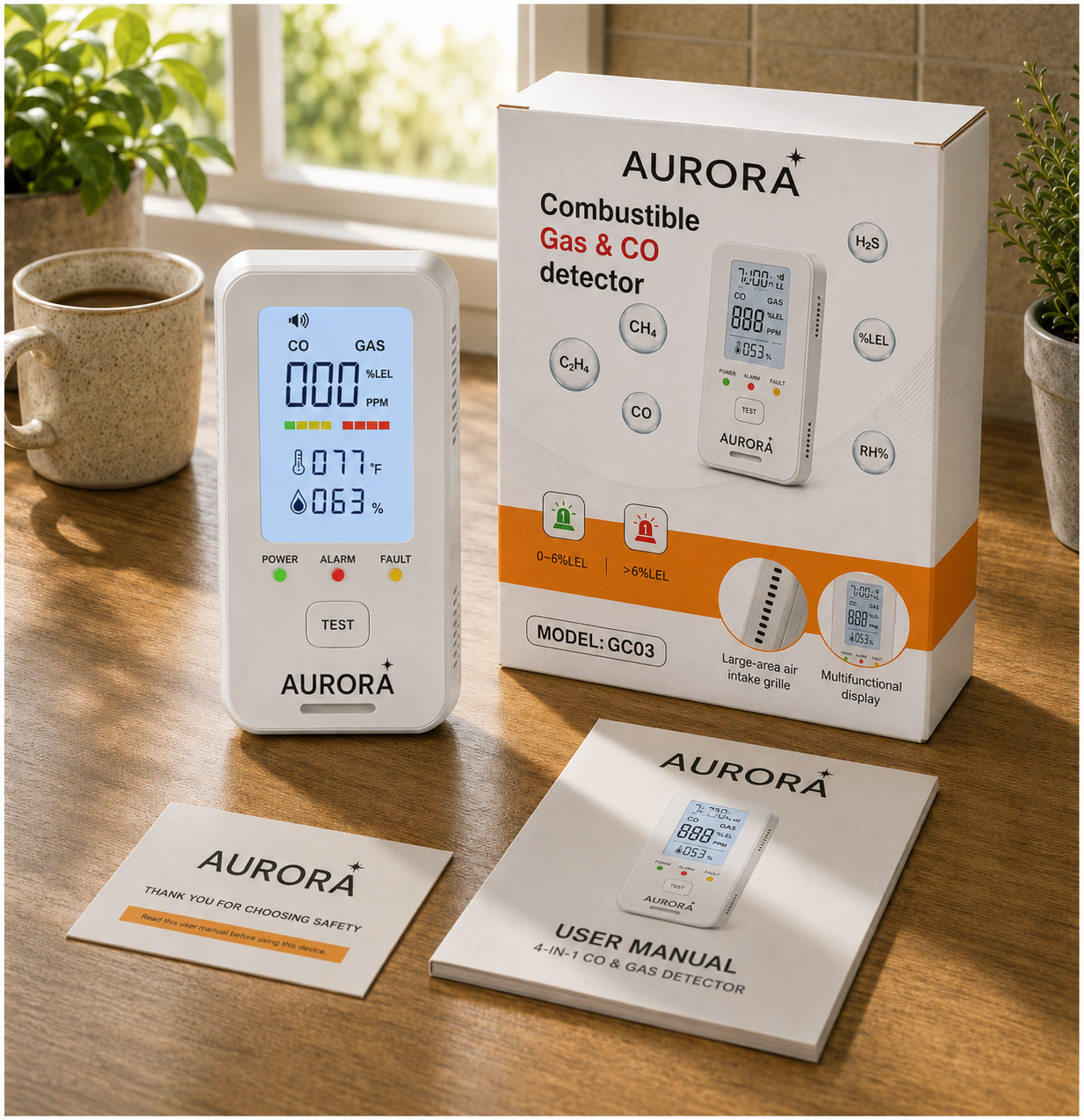
I eventually found one unit that did all four. The Aurora AirSentry. Carbon monoxide and combustible gas on one screen, with temperature and humidity alongside. Plugs into any standard mains socket — no wiring, no ceiling, no ladder.
I don't sell these. I fit whatever the customer brings me. But I have been asked what to have so many times, by so many people sitting in the same chair, that I've started giving one answer.

I want to be honest rather than dramatic about this, because I don't think you need dramatic.
Nothing spectacular happens on night one. That's rather the point.
No drama. No ambulance. Just a sooted burner found on a Tuesday morning with the kettle on, instead of on a February afternoon by a warden.
TODAY: You click the button. Choose your option. Enter your details. You'll get an order confirmation email within 3 minutes. (Check spam. Sometimes it goes there.)
48 HOURS: Your unit ships from our UK warehouse. You'll get a tracking number. Standard delivery takes 2-4 days via Royal Mail.
WHEN IT ARRIVES: Plug it into any standard mains socket, ideally at the sleeping end, at roughly head height. No screws. No ceiling. No app, no wi-fi, no pairing. The screen comes up and that's the installation finished.
NIGHT 1: It'll almost certainly read zero. Look at it anyway. That zero is the first actual fact anybody has given you about the air in that van.
WEEK 1: You'll learn your baseline. Heater on all evening. Cooking with the vent shut. Cold night, everything closed. Write it on the back of something if you like — most people don't need to, because they remember.
AND THEN: You'd notice the morning it was different. That's the entire purchase.
ONE MORE THING: Keep your existing alarm on the wall. I mean that. It's your last line and it should be there. It just shouldn't be the only thing you've got, which is what it is for almost everybody reading this.
The fifteen pound alarms are available everywhere because a light in a plastic shell costs almost nothing to make.
This is a two-sensor unit with a calibrated display, and it is made in production runs rather than continuously.
It has genuinely gone out of stock more than once.
Not a marketing line. When it goes, it goes for weeks, because the sensing components at this grade are not something you order on a Tuesday and receive on a Thursday.
And the season matters. Two thirds of these deaths happen in autumn and winter, when the heater runs all night and the van is shut up tight.
That's the half of the year you'd actually want it for.
You can carry on exactly as you are. The alarm stays on the wall. The habitation certificate goes in the glovebox. You press the button before every trip and it beeps and the green light comes back on.
And you go to bed in six cubic metres of air, every night of every trip, with no idea what's in it. The way you have for nine years, or eleven, or twenty.
Or you plug one in, for a full year, risk free. If it reads zero every single night for twelve months, you'll have learned that your van is fine — which is worth knowing rather than hoping — and you can send it back and get your money back.
No questions asked.
If your van is fine, you lose nothing but the time it took to find out properly.
And if something in your van is doing what things in vans occasionally do, you find out on a Tuesday morning with the kettle on.
Which is the only good way to find out.
I've been doing this twenty-two years. I've been into more motorhomes than I can count and I have never once — not one single time — had an owner tell me what carbon monoxide reading their van was sitting at the night before.
They know their tyre pressures. Their water level. Their leisure battery percentage. Their gas cylinder weight.
The one thing in that van that can hurt them while they sleep is the only thing they have no number for.
Over 20,000 of these units are now out there. The first owner I told about it rang me a month later because his reading wasn't zero one cold morning. Partly sooted burner. A morning's work and a new part.
Nothing happened to him.
You're next.
365 days. Full refund.
It's not for you? Day 2, week 2, day 300, any time. Email them. Full refund.
That's a full year — through an entire autumn and winter, which is the half of the year that actually matters for this.
Two questions to ask yourself:
Do you know what the alarm on your wall is required to do before it makes a sound?
And if the answer is no — how long have you been treating its silence as good news?
If you've read this far, you already know which one you are.
365-Day Money-Back Guarantee
A number instead of a light. For the one thing in that van you've never been able to check.
 GET THE BUY 1 GET 1 FREE DEAL →
365-Day Money-Back Guarantee · Fast Shipping · No-Hassle Returns · Safe & Secure Checkout
365-Day Money-Back Guarantee